
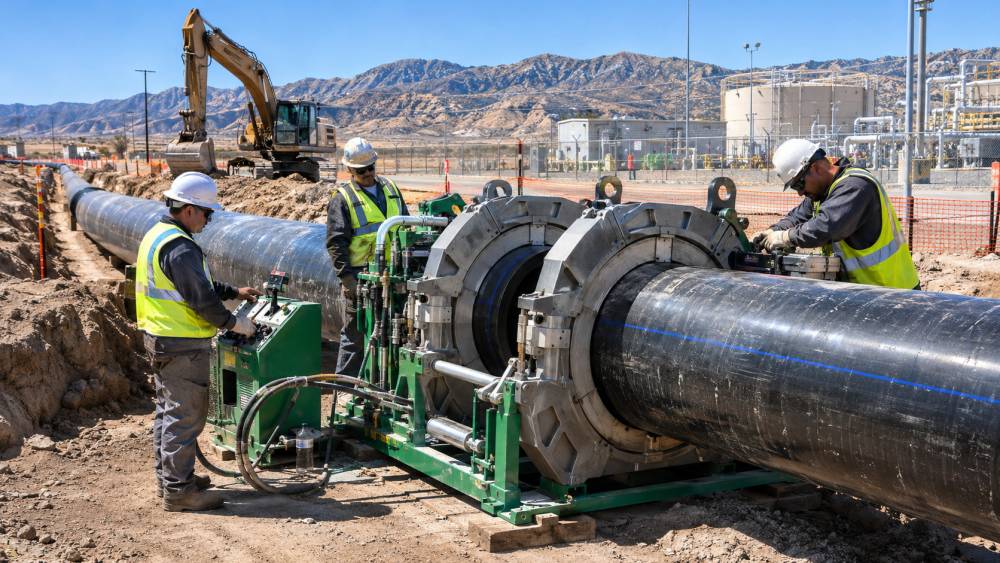
Industrial piping systems are often out of sight, but they are essential to the daily operation of mines, utility systems, treatment facilities, and large construction sites. Whether a pipeline transports process water, supports drainage, or connects a new facility to an existing network, the quality of its installation influences long-term reliability. High-density polyethylene (HDPE) pipe has become an important option for these applications because it combines flexibility, corrosion resistance, and the ability to create fused joints.
For contractors and facility owners, however, choosing the right pipe is only one part of the project. Successful HDPE pipeline installation requires careful planning, appropriate equipment, trained personnel, and consistent quality control from the first excavation to final testing. 4Granite Inc., a heavy civil and general engineering contractor based in Southern California, provides certified HDPE welding and installation services as part of its broader construction capabilities.
Why HDPE Is Used in Demanding Environments
HDPE is widely specified for water distribution, industrial fluid handling, drainage, and other piping systems where its material properties are a good match for the operating conditions. Unlike some metal piping materials, polyethylene does not rust. Its flexibility can also be useful where terrain changes, ground movement, or complex alignments make rigid piping more challenging to install.
The material is not a universal solution. Pressure ratings, temperature limits, chemical compatibility, exposure conditions, and installation loads must be evaluated before a project team selects a pipe product. Diameter, wall thickness, and fitting selection must follow the approved design and applicable specifications. A successful installation starts by matching the system to the real operating environment rather than assuming one pipe type fits every application.
The Importance of Site Evaluation and Planning
Before crews begin joining pipe, the project team needs to understand the route and the site. Existing utilities, excavation limits, access roads, environmental restrictions, laydown areas, and equipment movement all influence how the work will be organized. On active industrial properties, work may also have to be coordinated around production schedules, facility traffic, and other contractors.
A practical installation plan addresses material deliveries, pipe staging, fusion equipment locations, trench safety, inspection points, and the sequence in which pipe sections will be assembled and placed. The team also needs to consider how much room is available to move long pipe strings and how to protect pipe from unnecessary damage during handling. Early coordination reduces costly interruptions once construction begins.
How HDPE Pipe Fusion Works
One of HDPE’s most useful characteristics is the ability to join compatible pipe components through controlled heat fusion. In a typical butt-fusion process, pipe ends are secured in a fusion machine, aligned, faced to create clean mating surfaces, heated under specified conditions, and then brought together under controlled force. The completed joint must be allowed to cool according to the applicable procedure before it is handled or loaded.
This process involves more than pressing two pipe ends together. Equipment condition, correct heater temperature, alignment, cleanliness, fusion pressure, timing, and operator technique all matter. Crews must use procedures appropriate to the pipe and fitting manufacturer, project specifications, and applicable standards. Weather and site conditions also require attention, particularly when wind, dust, or moisture could affect preparation and joint quality.
Depending on the project, mechanical connections, flanges, valves, and other transition fittings may also be required. Each component introduces its own installation requirements. Properly executed fusion and carefully installed connections help create an integrated system that can be inspected and tested before being put into service.
Trenching, Bedding, and Pipe Placement
A reliable pipeline depends on the ground around it as well as the pipe itself. Trench depth and width must accommodate the design, required clearances, and safe working practices. Excavation crews must identify underground hazards and use protective systems where required by soil conditions, trench configuration, and safety regulations.
Bedding and backfill are particularly important. Unsuitable material or poorly controlled compaction can create point loads, voids, or uneven support. Crews should follow the project requirements for foundation preparation, bedding material, placement, and compaction. During lowering and placement, the pipe must be supported and handled in a way that avoids excessive bending, dragging, or damage to the exterior surface.
For exposed or aboveground systems, the design may instead require supports, restraints, protection from traffic, and allowances for thermal movement. The installation method should reflect the actual design rather than a one-size-fits-all construction approach.
Quality Control From the First Joint to Final Testing
Quality control should be part of the work sequence, not an inspection added at the very end. Depending on the specification, project documentation may include pipe identification, fusion parameters, operator qualifications, visual joint inspections, installation records, and testing results. Any joint or component that does not meet acceptance criteria should be addressed before it becomes difficult to access.
Pressure or leak testing, where specified, must be conducted under an approved procedure suited to the pipe material and system design. Test setup, stabilization, safety zones, and acceptance criteria require careful planning. Clear records help the owner understand what was installed and support future operations, maintenance, or repairs.
Working Safely at Active Industrial and Civil Sites
HDPE installation often overlaps with excavation, lifting operations, heavy equipment movement, and work near existing industrial infrastructure. That means safe execution depends on coordination between multiple crews. Traffic control, utility identification, lifting plans, protective equipment, and equipment exclusion zones should be established for the conditions on each site.
On mines and other regulated properties, additional site-specific training and operating rules may apply. 4Granite’s published qualifications describe experience in heavy civil construction and safety training relevant to industrial environments. Every project still requires its own hazard assessment, permits, and agreed work controls before crews begin.
An Experienced Construction Partner Matters
A pipe installation is only as dependable as the full construction process supporting it. Teams must coordinate engineering requirements, material handling, fusion, excavation, bedding, backfill, connections, and final verification. A contractor familiar with both pipeline installation and broader civil work can help manage those interfaces and keep the project moving.
4Granite Inc. lists certified HDPE welding and installation among its core services. Its project history includes industrial piping and utility work, including a documented installation of more than 13,000 feet of HDPE pipe with associated tees and valves. That experience reflects the kind of coordination required on substantial industrial projects.
Discuss Your HDPE Pipeline Project With 4Granite Inc.
Whether the scope involves a new HDPE piping system, an expansion, replacement piping, or supporting earthwork, early discussion helps identify the construction requirements and possible challenges. Share the intended use, pipe size, site location, operating conditions, available plans, and schedule with the project team.
4Granite Inc. serves public- and private-sector construction customers from its Southern California base. To discuss certified HDPE pipe welding and installation, contact the team through 4GraniteInc.com or call (760) 403-3376.